Practice abstract 5
Value chain analysis of Akpan in Benin
19 July 2025
Background. Akpan is a traditional cereal-based fermented product, valued for its smooth, yoghurt- like consistency. Cereals used are mainly maize, with some minimal sorghum. Akpan is predominantly consumed in Benin and across West Africa, just after lunch, or as a refreshing snack between lunch and dinner. It is mainly produced in the south of Benin as a street food.
Objective. The main objective is to provide a general overview of the Akpan value chain in Benin and to describe the product process and characteristics.
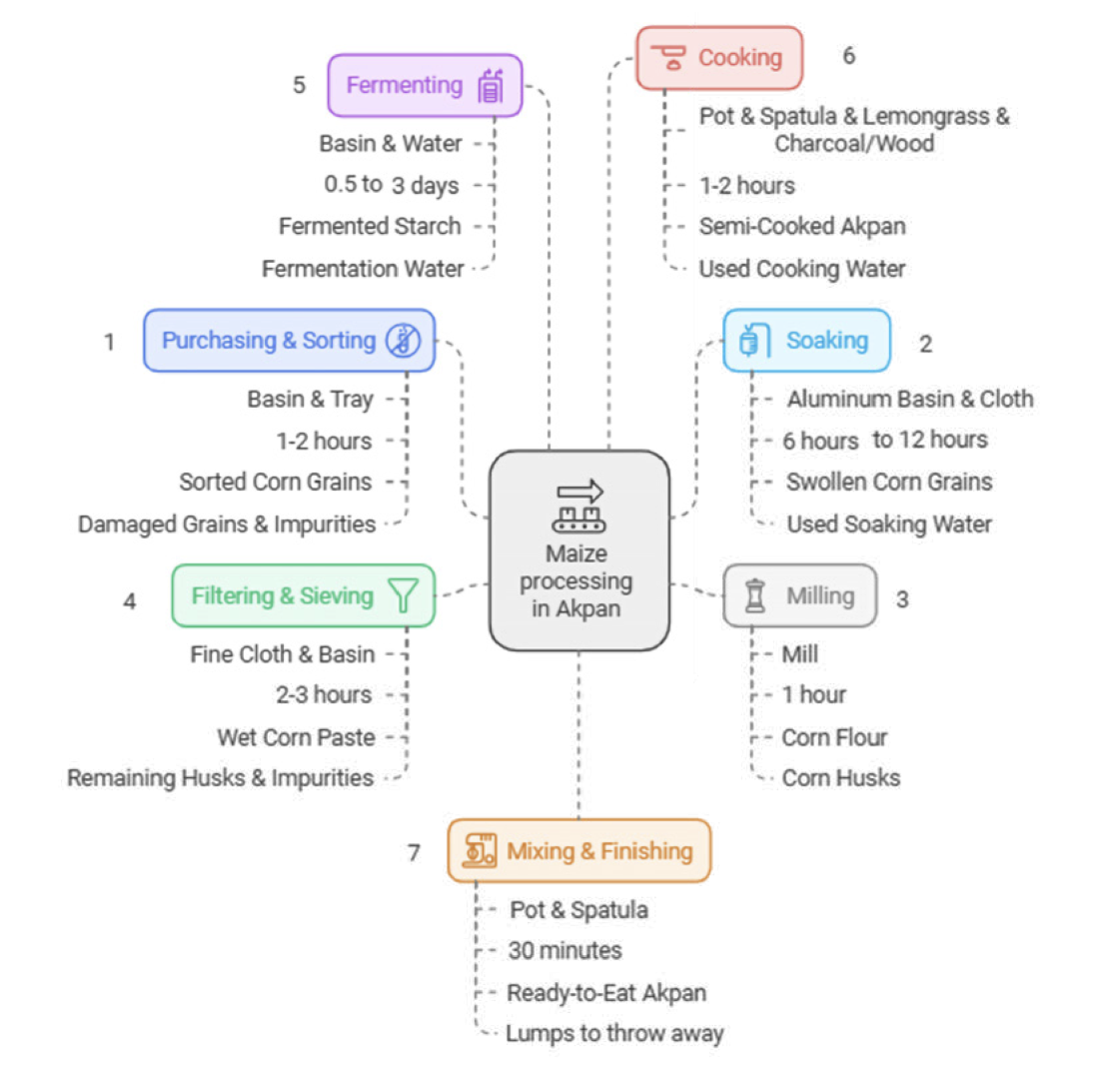
Results. To obtain Akpan, processors extract starch from cereals, ferment it and then precook it. Starch extraction starts with grain sorting. In the case of maize, grains are soaked for 6-24 hours in cold or warm water, followed by milling of soaked and drained grains and wet sieving to separate starch from hulls. For sorghum, sorted and dried grains are milled and dry-sieved, then soaked for
6 hours. The extracted starch is fermented spontaneously with the sieving water on top for 24 to 72 hours. The fermented starch is finally precooked to obtain Akpan.
A high quality Akpan should be smooth and lump free with a pleasant aroma, and a slightly acidic taste. The results reveal several major quality and safety challenges for the value chain, such as lack of applicable quality standards and control measures associated with lack of knowledge of the actors concerning food hygiene. Although the study seems to reveal a low level of mould contamination in Akpan, poor drying and storage conditions of cereals are revealed as being sources of mould contamination. Two case studies consisting of two groups of interconnected business operators within the Akpan value chain have been selected.
Recommendations. An in-depth analysis of the case studies, based on a precise multi-dimensional approach by a team -including socio-economists, microbiologists and food technologists- will enable the development of recommendations.
Graphics